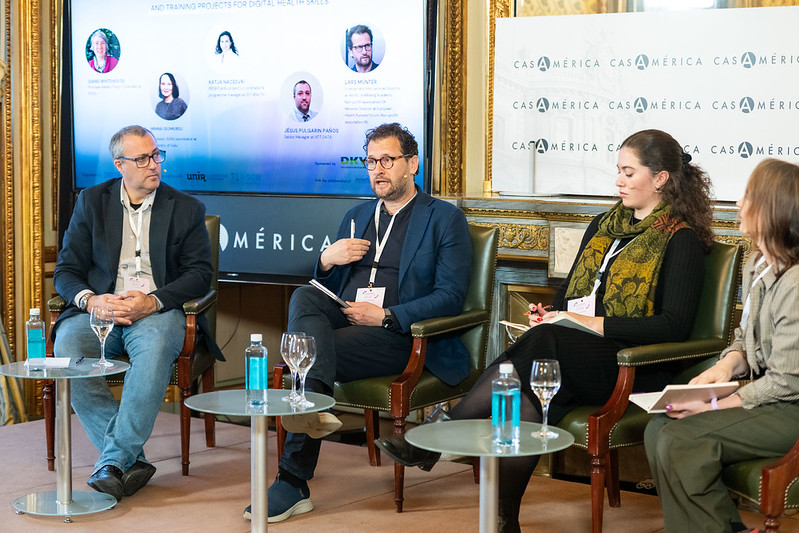
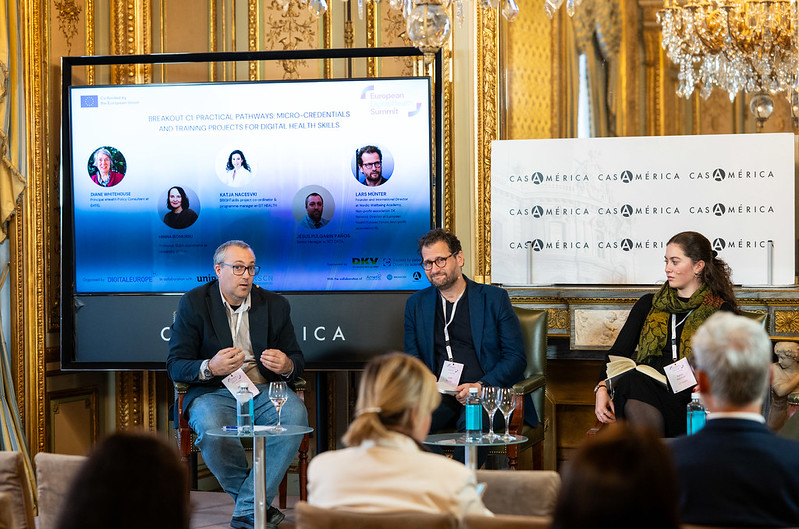
On 1–2 December 2025, BRIGHTskills represented by Project leader, Katja Nacevski (Programme Manager - EIT Health), participated in DIGITALEUROPE’s European Digital Health Summit in Madrid, Spain at the breakout session “Practical Pathways: Micro-credentials & Training Projects for Digital Health Skills”.
The panel brought together three EU projects funded by the Erasmus+ and Digital Europe programmes who have similar stakeholders and objectives to upskill and reskill the health sector’s workforce.
Moderated by Diane Whitehouse (Principal eHealth Policy Consultant - EHTEL), industry leaders and academic representatives discussed how Europe can move from fragmented training initiatives to scalable, trusted and action-oriented digital health skills development. Panel members echoed the main messages advocated throughout the Summit. That is - the urgent need for upskilling in AI and cybersecurity, the value of European support for large-scale skills programmes, and - crucially - the challenge of identifying “what’s next” when it comes to skills resilience, flexibility, scalability, and turning learning into action.
Trust as the Cornerstone of Skills Recognition
Europe’s digital health workforce challenge not only concerns developing new skills but is also about building trust in how those skills are recognised.
As explained by Ms Nacevski healthcare companies repeatedly stressed, during the establishment of the Health Industry Skills Partnership and later the BRIGHTskills project, the need to trust education and training qualifications- whether from higher education, vocational education and training (VET), or continuous professional development programmes. This trust is essential for employee recruitment, retention and for delivering on-the-job training and development programmes. While skills and qualifications are recognised and transferable at national level, portability remains a challenge between Member States impacting employer’s candidate pools and job seekers hiring opportunities.
From the learner’s perspective, the situation is equally complex. With countless online courses and micro-credentials available, professionals entering or already working in digital health often struggle to determine which qualifications and skills employers recognise and value.
Embedding Digital Skills for Scalability and Sustainability
Concrete examples of how to address uptake and implementation of new educational programmes came from Prof. Minna Isomursu (University of Oulu) and the SUSA project, where 12 pan-European universities are embedding digital skills training into their existing curricula. A key lesson from SUSA is that micro-credentials do not scale if they are not embedded in university systems.
One practical example highlighted the importance of embedding and contextualising AI training for students. For example, nurses may be given tools and resources such as Microsoft Teams or Copilot Prompts, but they also need guidance on generative AI, including what not to do - such as entering sensitive patient data that risks identification. This underlines the importance of simultaneously educating the workforce about the ethical, data protection, legal, and cybersecurity issues connected to use of digital tools in their workplaces.

Inclusion, Incentives and Designing for Use
A strong user-centred perspective was brought to the discussion by Lars Munter (Network Director - European Health Futures Forum), who drew a comparison with everyday technologies, pointing out that nobody received formal training to use platforms like Facebook or TikTok—yet we use them because they deliver clear purpose, value and outcomes.
From this perspective, inclusion should not be an afterthought or a burden. Innovation in digital health should be designed so that extensive training is not required simply to use a solution. If this is not yet the case, it signals the clear need to rethink design approaches.
Mr Munter also stressed that innovators must be able to explain their solutions beyond their professional networks. This requires equipping developers with the communication skills required to detail the product’s value, impact and relevance to policymakers, healthcare providers and patients.
Finally, he highlighted that micro-credential training and modules are not beneficial, nor will scale, without incentives linked to career progression, organisational recognition or regulatory frameworks - all essential to drive adoption and deployment at scale.
Real-World Readiness and Interoperability
From an industry perspective, Jesus Pulgarin Panos (Senior Manager - NTT Data) emphasised that training initiatives must be grounded in the real-world reflecting actual market and system needs. In the context of digital health, this includes a strong focus on interoperability, particularly in light of the European Health Data Space (EHDS).
For projects like XiA, success is measured not just by participation numbers, but by the impact of professionals’ confidence and competence to bring digital innovation into healthcare systems. Courses should be continuously adapted to real customer use cases, ensuring the best possible fit with market realities and organisational needs.
Turning Learning into Action
While Europe has made significant investments in AI, cybersecurity and digital skills, the challenge is to ensure that these efforts translate into flexible, scalable and resilient learning pathways that lead to tangible change in healthcare systems.
Panellists unanimously highlighted the value of cross-project collaboration, which can enable alignment on training delivery formats, skills strategies, and competence frameworks.
“Humble courage” was also called for within organisations, including public entities, as end-users and those with industry expertise can offer valuable insights to innovators and public institutions.
For BRIGHTskills, the Health Industry Skills Partnership remains a key mechanism to ensure that education and training stay relevant, trusted and impactful for employers and healthcare companies.
Turn digital skills into meaningful action and shape Europe’s digital health workforce by joining EIT Health’s Health Industry Skills Partnership today!